

County approves $9.1B budget
Record spending plan leans on reserves and outside funding to maintain balance as personnel, healthcare and long-term costs continue to outpace local revenue growth


SAN DIEGO — The county Board of Supervisors unanimously approved a record-high $9.1 billion budget last week, which features a $522.5 million increase in expenditures over the prior fiscal year.
The fiscal year 2026-27 budget reflects the county growing in its role as a provider of health and safety-net services, with spending dominated by personnel and contracted programs. In addition, the budget is heavily dependent on federal and state funding, and a growing reliance on dwindling reserves to maintain fiscal balance amid uneasy economic times.
While county officials describe the budget as balanced, an analysis of the county’s revenues and expenditures shows a system under strain as recurring costs outpace local revenue growth and the county remains exposed to federal and state policy shifts and budget deficits.
“Today we are voting on a balanced budget, and I think it’s a pretty extraordinary budget,” Chairwoman Terra Lawson-Remer said. “It protects the core services that San Diegans count on. Public safety, fire emergency response, behavioral health, healthcare, food assistance, homeless services, veteran services, parks, libraries, arts, roads and the day-to-day work of our county government.”
The county’s largest expenditure is allocated to personnel and contracted services to deliver programs ranging from mental healthcare to public safety. The largest category, Professional and Special Services and Contracts, totals $2.46 billion (26.9%) of the budget.
The money pays for outside providers, including hospitals, clinics, nonprofits, and private contractors, to carry out many of the county’s core programs.
Spending on county employees is $2.19 billion (23.9%), while retirement costs total $1.03 billion (11.2%), and employee benefits, insurance, and other compensation account for several hundred million dollars. Those employee expenses are more than $3.77 billion and represent more than 41% of the budget.
About 14% of expenditures consist of internal financial flows, including $605.7 million in operating transfers out, $567.4 million reimbursing other departments and funds, and more than $90 million in interfund expenditures. The county moves this money within its complex financial structure, but it does not represent new external spending.
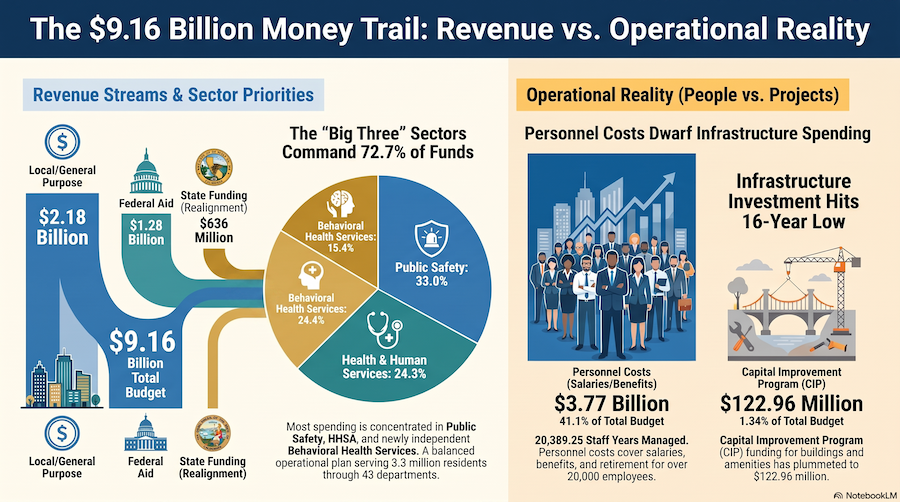
But one of the most notable expenditures, the Capital Improvement Program (CIP), has a budget of $122.96 million, or 1.34% of total expenditures, a 16-year low. The program is dedicated to buildings, improvements and other infrastructure. A broader CIP spending plan totals $165 million when accounting for infrastructure and IT projects.
